
The Success of Malta’s Nomad Residence Permit: 2 Years On
In recent years, the rise of the digital nomad lifestyle has transformed the way we work and live. One destination that has emerged as a hotspot for these globe-trotting professionals are the picturesque Mediterranean islands of Malta and Gozo. Just over 2 years on from the launch of the Malta Nomad Residence Permit, the Government Agency which handles Malta’s Nomad Residence Permit, the Residency Malta Agency, has recently issued some key statistics that indicate the global reach and success of Malta’s digital nomad visa option.
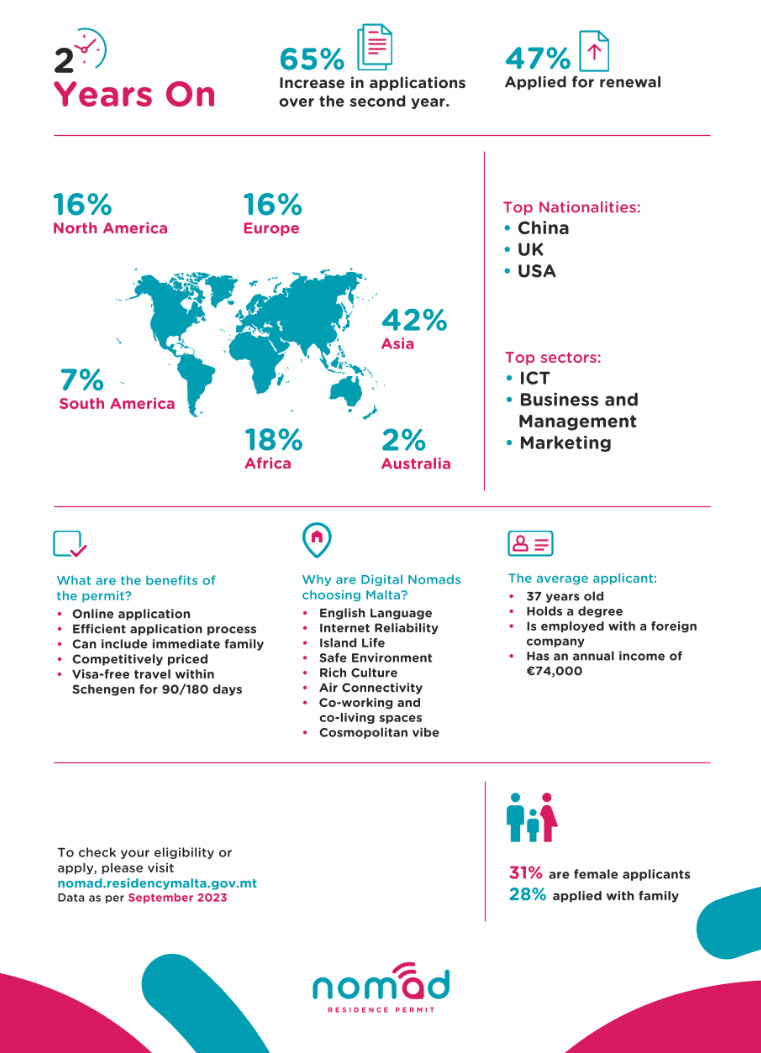
Statistics as published on the Residency Malta Agency’s LinkedIn page in mid-November 2023.
2 Years On - Increase in Applications and Renewal Rate
Malta’s digital nomad permit has seen an impressive 65% increase in applications over the second year since its launch, demonstrating its robust appeal to the global digital nomad community. Simultaneously, a 47% renewal rate also suggests a high level of satisfaction among permit holders and their willingness to continue enjoying the unique benefits Malta offers, notwithstanding the renewal requirements of having to prove at least 5 months of presence in Malta during the year preceding the renewal, as well as proof that the applicant has paid tax on their income in their jurisdiction of tax residence.
Geographical Segments and Top Nationalities
As the numbers show, Malta is increasingly attracting digital nomads from every corner of the world. Currently, 65% of applicants are from North America, 42% from Asia, 18% from Africa, 7% from South America, and 2% from Australia. Malta’s digital nomad community is diverse, with the top nationalities being from China, the UK, and the USA. This melting pot of cultures makes Malta an even richer and more vibrant place, providing opportunities for exceptional networking and international friendships.
It is interesting to note that a good percentage of the digital nomad applicants would already enjoy visa-free access to Malta and the Schengen area on the basis of their nationality. In other words, the fact that such individuals are opting for Malta’s Nomad Residence Permit and subsequently renewing their permit, evidences the applicants’ genuine intention to reside in Malta for extended periods and in turn contribute to Malta’s economy, talent pool, and cultural diversification.
Applicant Profiles - Sectors and Average Applicant
Looking at the data more closely, we notice diversity in not only geographical origin but also professional sectors. The top sectors digital nomads work in are Information and Communication Technology (ICT), Business and Management, and Marketing. The average Malta digital nomad applicant is 37 years old, holds at least one degree, is employed by a foreign company, and earns approximately €74,000 annually. Within this vibrant community, 31% of applicants identify as female, and 28% have opted to include their family members in their application. Given that the minimum annual income threshold requirement to apply for the Malta Nomad Residence Permit is EUR 32,400, the fact that the average applicant earns around €74,000 annually is another positive indicator of the quality of applicants that Malta’s digital nomad visa options is attracting to our shores.
Why are Foreign Nationals Choosing Malta and Gozo to work remotely?
The Maltese islands, mainly consisting of Malta as the mainland, the sister island of Gozo, as well as the smaller island of Comino, stand out as a digital nomad destination due to the English-speaking environment, reliable Internet connectivity, and the appealing island lifestyle. The country offers a safe environment, rich culture, and excellent air connectivity. Furthermore, Malta’s co-working and co-living spaces, coupled with its cosmopolitan vibe, provide a supportive framework and social opportunities for digital nomads.
The Benefits of Malta's Digital Nomad Permit
Malta’s digital nomad permit offers multiple advantages, allowing digital nomads to work and live comfortably on the island.
- Online application: The permit application process is entirely online, making it easy for eligible applicants from across the globe.
- Efficient application process: Expect a swift application process, enabling you to focus on your work rather than bureaucratic procedures.
- Family inclusion: The permit allows you to bring your immediate family, ensuring you don’t have to leave your loved ones behind.
- Competitive pricing: Malta’s digital nomad permit is priced affordably, ensuring remote workers from various walks of life can access it.
- Reside in Malta: This one might be obvious, but as the statistics show, the main driving force for applicants seems to be the opportunity to live and work remotely from the Maltese islands.
- Visa-free travel within Schengen: In addition to residing in Malta, permit holders can travel freely within the Schengen zone for up to 90 days within a 180-day period. No one seems to mind an European city weekend break!
Why Digital Nomads Choose Malta?
There are several reasons why digital nomads are drawn to Malta. Here are some of the most compelling factors:
- English language: Malta’s official language is English, which makes communication and networking easy for digital nomads.
- Internet reliability: The nationwide 5G mobile internet service ensures fast and stable connectivity for remote professionals.
- Island life: Enjoy the Mediterranean lifestyle surrounded by beautiful beaches, lush landscapes, and blue seas.
- Safe environment: Malta’s reputation as a safe country, boasting low crime rates and a welcoming atmosphere.
- Rich culture: Explore Malta’s incredible history, fascinating architecture, and unique traditions.
- Air connectivity: Located strategically in the Mediterranean, Malta offers convenient flights to Europe, North Africa, and the Middle East.
- Co-working and co-living spaces: Find an abundance of co-working spaces and co-living environments tailored to digital nomads.
- Cosmopolitan vibe: Immerse yourself in a diverse and vibrant expat community.
The Benefits of the Programme!
How to Apply for Malta’s Digital Nomad Visa?
The digital nomad permit in Malta offers various benefits, including a completely online application process, an efficient processing system, and an affordable pricing model. More importantly, it allows the inclusion of immediate family and permits visa-free travel within the Schengen zone for 90/180 days, further enhancing its appeal.
The process is pretty straightforward, in fact we can walk you through it in 10 easy steps:
- Step 1: Schedule your free eligibility assessment with Dr Russell Attard Baldacchino.
- Step 2: If you’re eligible, send us your passport data page, CV, and proof of residential address so that we can run our preliminary due diligence checks;
- Step 3: You’ll receive our Engagement Letter for signature via DocuSign and our invoice will follow;
- Step 4: We’ll set up a group chat on your preferred messaging app (we appreciate everyone’s unique security preferences)
- Step 5: You’ll receive a tailor-made checklist of documents, specifically designed for your case. All you have to do is share the information and digital copies of the documents we request. There’s no need to fill in any forms, draft any letters or declarations, or try to figure out how to structure and submit your application; our team will do all of that for you!
- Step 6: You’ll receive all the completed forms or documents that you’d need to print and sign in wet blue ink, and share just the scanned copies with us.
- Step 7:Our dedicated Nomad team will submit your application to the Residency Malta Agency, and you’ll be kept in copy for all official correspondence.
- Step 8: After an initial application completeness and admissibility check by the Residency Malta Agency, you’ll receive an official application submission receipt and application fee request (that’s just EUR 300 per applicant).
- Step 9: Transfer the application submission fee directly to the Residency Malta Agency from your personal bank account. Once the receipt of funds is issued, your application processing will begin.
- Step 10: Assuming no major feedback is raised by the Agency during application processing, you can expect to receive the application decision within around 4 to 6 weeks.
How much does the Malta Nomad Residence Permit Cost?
Malta’s digital nomad visa option is a relatively cost-efficient solution to acquire a temporary period of residency in Malta for up to 3 years. Here’s a breakdown of the fees you can expect:
- Professional Fee: This would be the fee charged by the service provide or licensed agent that you may opt to engage for their professional experience to guide you through the application fees. Professional fees typically range from around EUR 2,000 to EUR 5,000 for a sole applicant, and additional fees may apply if other family members are also included in the nomad residence permit application and Schengen visa process. We offer free 30-minute consultation sessions, whilst adopting a strictly confidential and a no-obligation quotation process.
- Residency Malta Agency Application Fee: A EUR 300 fee per applicant is paid directly to the Residency Malta Agency after submission of the application. An official application submission receipt and payment request is issued by RMA after verifying that the respective application was admissible. The RMA Nomad team are very efficient, and normally get this done in just a day or two.
- Premium Visa Fee: A fee of EUR 300 applies for those who opt for this Premium Visa Service, and the great thing is that the fee is standard, even if there’s more than one passport.
- Card Printing Fee: At the biometrics collection appointment, a fee of EUR 27.50 per residence card to be printed must be paid by the applicant using their bank debit or credit card at the Residency Malta Agency’s offices.
- Health Insurance Coverage: Unless you’re a UK citizen, you’ll need to have an adequate Health Insurance Policy in place, with a minimum of EUR 30,000 limit, covering both in-patient and outpatient cover, for Malta. Including cover for Schengen travel is advisable if you’ll be moving around. Basic policies start at just a few hundred Euro, depending on the age of the insured.
- Accommodation: Don’t underestimate the strict accommodation requirements or costs. Applicants must submit proof of a legal residential lease agreement that has also been registered with the Housing Authority Rent Registration unit, and which must specifically cover the 12-month validity of the residence permit to be issued. Whilst having the liberty to choose between a private or shared residential lease agreement, one should keep in mind that since shared accommodation lease agreements can only cover a maximum period of 6 months, in the case of shared accommodation lease agreements, two or more back-to-back agreements may be needed. You could find shared accommodation lease options starting at around EUR 400 p/m, and private units starting at around EUR 800 p/m. You can schedule an e-meeting for more details on qualifying accommodation options in Malta for digital nomads.
For a more detailed breakdown of the application process, visit our main Malta Nomad Residency Page Where we explain in further depth the process then contact us so that we can guide you every step of the way and help you transition smoothly into your new life. Are you ready to immerse yourself in the Maltese lifestyle and propel your career to new heights? Apply now!
This blogpost is being published strictly for informational and educational purposes, and should be correct and accurate at the time of publication. The content of this publication should not be considered as formal legal, immigration, or tax advice.
recently post
Maltese Easter Traditions

Vacancy Alert: Junior Client Liaison Officer -Filipino Speaking
FAQ: Nomad Residence Permit
A Shining Example: Honouring Our Employee of the Year on International Women’s Day
Understanding Maltese Property Purchasing Laws and Procedures
From Aspirations to Reality: A Guide to the Maltese Real Estate Market
© Attard Baldacchino 2024. All Rights Reserved.